
A woman in her mid forties comes in tired. She is not sleeping well. She is more anxious than she used to be, her cycles have gotten unpredictable, her memory feels slower, and she cannot lose the weight that has settled around her middle. She has usually been to at least one other doctor, who checked her thyroid, told her the labs were normal, and suggested she was stressed.
She is not imagining it. She is in perimenopause, and the reason her labs looked fine is that in perimenopause the labs frequently do look fine.
What perimenopause actually is
Menopause is a point in time, defined as twelve consecutive months without a period. Perimenopause is the stretch leading up to it, and it commonly begins in the late thirties or early forties. It can last several years.
The defining feature is not low hormones. It is unstable ones.
Estradiol does not decline in a tidy line. It swings, sometimes to levels higher than in a normal cycle and sometimes very low, occasionally within the same month. Progesterone tends to fall earlier, because ovulation becomes inconsistent and progesterone is produced after ovulation. Testosterone drifts down gradually.
This is why a single blood draw so often fails to explain anything. Draw on the wrong day and everything reads normal. The problem is the volatility, and volatility does not show up in one snapshot.
What that instability produces
The symptoms track the hormones that are moving.
Falling and erratic progesterone shows up as insomnia, anxiety, mood swings, and worse premenstrual symptoms. Women often describe it as feeling wired at night and flat during the day.
Swinging estrogen produces hot flashes, night sweats, disrupted sleep, mood changes, and the cognitive complaints that get dismissed as brain fog. The cognitive symptoms are real, and they are anything but rare: in one survey of nearly 6,000 women, brain fog topped the entire symptom list.
Falling testosterone contributes to fatigue, low libido, reduced motivation, loss of muscle, and a general sense that your drive has dulled. In women this gets under-recognized almost universally, partly because testosterone is thought of as a male hormone and partly because it is often blamed on being busy.
Meanwhile body composition changes. Estrogen loss shifts fat toward the abdomen, insulin sensitivity declines, and muscle becomes harder to hold onto at exactly the age when protein intake usually drops. Women describe getting heavier while eating the same way, and they are right.
Put just the symptoms related to the brain and nervous system on one chart and the story tells itself: they dominate perimenopause, and the one symptom everybody associates with this transition, the hot flash, sits in fifteenth place.
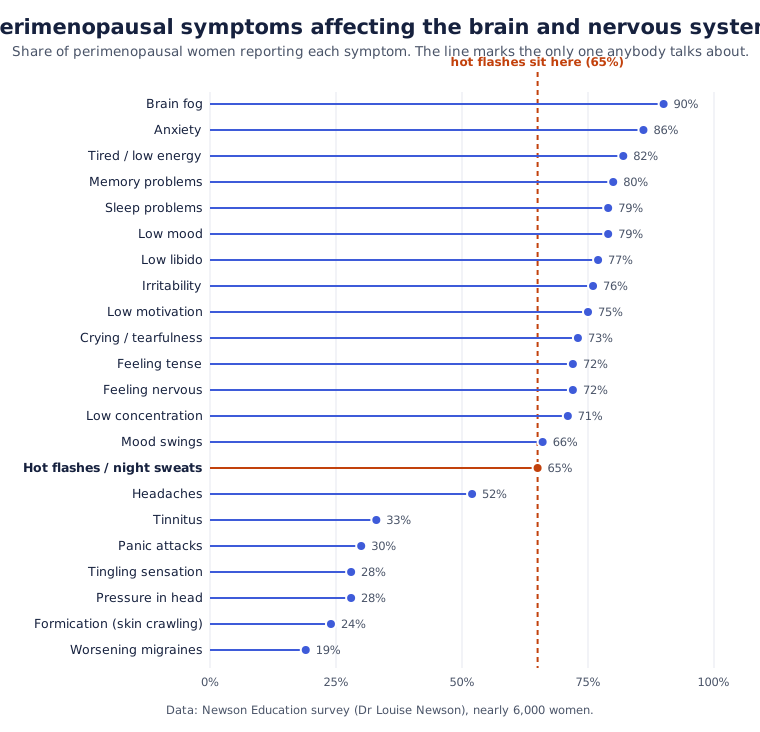
The full symptom list runs far longer than this chart, from joint pain to bladder leakage to dry eyes.
Why it gets missed
Every one of those symptoms overlaps with something else. Fatigue looks like thyroid disease. Anxiety and low mood look like depression. Sleep disruption looks like stress. Weight gain looks like aging.
So a woman gets a thyroid panel, a normal result, and a suggestion to exercise more. Sometimes she gets an antidepressant, and she has plenty of company: antidepressant prescriptions in women roughly double across the perimenopausal years, while men of the same age show no similar rise. That difference is not a mystery. It is a hormonal transition being read as a psychiatric one. What she rarely gets is anyone connecting the symptoms to each other and to her reproductive stage.
The other reason is diagnostic. Menopause is a clinical diagnosis, made from the pattern and the history, not from a lab value. Perimenopause is the same, only harder, because there is no twelve month marker to point at. Clinicians who are used to treating numbers have very little to hold onto, so they conclude nothing is wrong.
What to do with this
If this describes you, the useful thing is not to demand a specific test. It is to bring the whole picture to someone at once. The pattern is the diagnosis.
Track your cycles, including how the length has changed over the past couple of years. Note when the sleep and mood symptoms happen relative to your cycle. Bring your full symptom list rather than the one you think is most legitimate to complain about, because the connections between them are the point.
If you want to see where you land, my free symptom check walks through every area in a few minutes, scores it, and nothing you enter leaves your browser. When you are done, you can either send it in or print it and take it with you to your provider.
There are real options. Hormone therapy is one of them, and the evidence increasingly favors starting during perimenopause rather than waiting until you have crossed some threshold. Protein intake, resistance training, sleep, and fiber all matter more in this decade than they did in the last one, and they work alongside hormone therapy rather than instead of it.
What I would push back on is the idea that this is simply what your forties are. Feeling like a stranger in your own body for five years is common. That does not make it necessary.