
People assume testosterone is the male hormone and estrogen is the female one. It is a tidy story and it is wrong, and the cost of believing it is concrete: women whose low testosterone never gets treated, and men whose estradiol never gets measured.
Men and women share the same major hormonal systems. What differs is the amounts each of us produce, the ratios between them, the timing of when they rise and fall, and how our tissues respond. Not the cast of characters. The arrangement.
How I ended up here
I trained as a urologist in a program where my chairman was fellowship trained in andrology, so we got far more exposure to it than most residents do. Andrology deals with male hormones, fertility, and sexual function, and it is a fairly narrow corner of the specialty. That exposure turned out to be the best possible preparation for thinking about women's hormones, which is not something I expected at the time.
Andrology forces you to work in the actual machinery: how the brain signals the gonads, how hormones get bound and released by carrier proteins, how one hormone converts into another, what happens when a feedback loop gets disrupted. Once you know that machinery in men, you find that the same machinery is running in women, wired slightly differently.
I did not leave urology for hormones. The work I was already doing led directly into it.
The same parts, arranged differently
Testosterone is the clearest example. Women produce it, from the ovaries and the adrenal glands, and it matters enormously for them. Low testosterone in a woman shows up as fatigue, low libido, reduced motivation, mental dulling, loss of muscle and strength, and a flattened sense of well being. Those are the same complaints men bring in with, and in women they get attributed to stress or aging almost every time.
There is a measurement quirk here that fools clinicians, not just patients. Testosterone and estradiol are reported in different units, so comparing the raw numbers on a lab report gives you nonsense. Put them in comparable physiologic terms and a healthy woman in her twenties is carrying four to ten times as much testosterone as estradiol.
Read that again, because it runs against everything the culture tells you. Testosterone is one of the dominant circulating hormones in women. It simply does not look that way on paper, and only because the two hormones are reported in different units.
Estrogen is where the mirror image idea breaks down, and the reality is more interesting than the tidy version.
First, estrogen is not one molecule. There are three that matter. Estradiol, written E2, is the most potent and the biologically dominant one, and it is what people are almost always talking about when they say estrogen. Estrone, E1, is weaker and comes largely from androstenedione, and it becomes the dominant estrogen as a woman ages past menopause. The two behave differently in a way that matters: estradiol acts as an anti-inflammatory hormone, while estrone leans pro-inflammatory, and researchers have tied the rising estrone-to-estradiol ratio after menopause to inflammation in fat and breast tissue. Estriol, E3, is minimal outside of pregnancy. When this article says estrogen, it means estradiol.
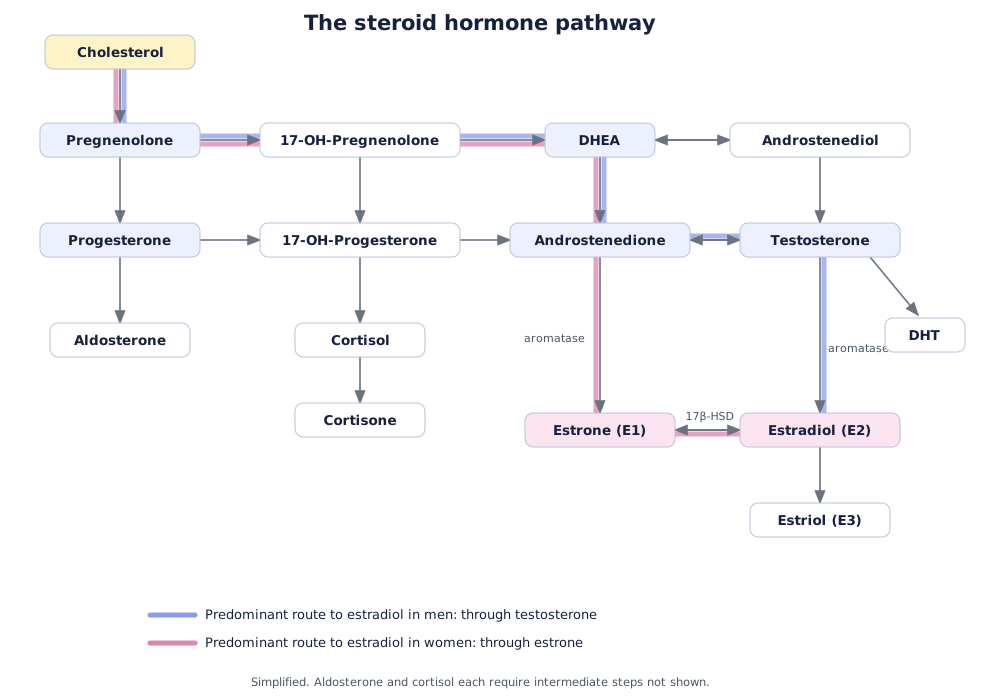
Second, it is tempting to say testosterone is the male hormone women also have, and estrogen is the female hormone men also have, as though the two run in opposite directions. They do not. The conversion runs the same direction in everybody. An enzyme called aromatase converts androgens into estrogens, and it does it irreversibly. There is no route back. Estradiol sits downstream of testosterone in men and in women alike.
In men, roughly 80 percent of circulating estradiol is made exactly that way, converted from testosterone and other androgens out in the tissues rather than produced directly. The testes secrete the other 20 percent or so themselves. So the dominant route is conversion, but it is not the only one, and that is true of most of this system. There are almost always secondary pathways running alongside the main one.
Testosterone itself follows the same principle. About 95 percent of a man's testosterone comes from the testes, with the adrenal glands supplying the small remainder. In women the ovaries and the adrenals both contribute, with peripheral conversion adding more on top.
In women it is the same chemistry at a different address. Inside the ovarian follicle, one cell type produces androgens in response to LH, and the neighboring cell type aromatizes those androgens into estradiol in response to FSH. A woman's estrogen is built out of androgen precursors. After menopause, when the ovary stops doing this, conversion in fat and other peripheral tissue becomes the main source, and what that tissue mostly makes is estrone, the pro-inflammatory one.
So androgens are not something women merely tolerate. They are the raw material a woman's estrogen is built from, mostly by way of androstenedione, while her testosterone does its own separate work in brain, muscle and bone.
Men truly need the estradiol they produce, and they carry more of it than most people would guess: a typical adult man has more circulating estradiol than a postmenopausal woman. It preserves bone density, supports libido and erectile function alongside testosterone, contributes to cardiovascular and cognitive health, and supplies the feedback signal that regulates the whole system. Men whose estradiol is driven too low get joint pain, low libido, erectile difficulty, and bone loss. Suppressing a man's estrogen aggressively is not a win, and I see it done.
Conversion is where it gets interesting
Hormones are not fixed quantities. They convert into each other, and where that happens changes the outcome.
Every steroid hormone you have, in either sex, starts as cholesterol. Cholesterol becomes pregnenolone, and pregnenolone is the common ancestor of progesterone, DHEA, testosterone, and the estrogens. Which one you end up with depends on which enzymes are active in which tissue.
Aromatase, the enzyme that turns testosterone into estradiol, is concentrated in fat tissue. That single fact explains a great deal of what I see. A man carrying significant excess weight converts more of his testosterone to estradiol. Estradiol suppresses the brain's signal to the testicles more strongly than testosterone does. So he makes less testosterone, converts more of what he makes, and the loop tightens. This is one of the most common causes of low testosterone I encounter, and it is frequently reversible.
The same enzyme matters on the women's side. After menopause, when the ovaries stop producing, peripheral conversion in fat and other tissue becomes the main source of what is circulating, and what that conversion mostly yields is estrone, the pro-inflammatory form, because the precursor reaching the fat is largely adrenal androstenedione, with only a small contribution coming through testosterone. The whole map, with each sex's predominant route to estradiol traced, looks like this:
The carrier protein nobody mentions
Most of your sex hormones are not free. They are bound to a protein made in the liver called sex hormone binding globulin, and while bound they cannot enter cells or do anything.
In men, roughly 60 to 65 percent of testosterone is tightly bound to it. Only 1 to 2 percent circulates completely free. The free portion, plus the loosely bound portion, is what actually reaches your tissues.
This is why the total number on your lab report can be misleading in either sex. That protein rises with age and falls with obesity and insulin resistance. So two people with identical total testosterone can have quite different amounts available, and the one whose binding protein is high can have real symptoms while being told everything is normal.
Why this changes how I practice
Three things follow from all of it.
The first is that chasing one number is a mistake. Hormones operate as a connected system with feedback loops and conversion pathways. A single value pulled out of that context tells you less than people think, and treating the number rather than the person produces both overtreatment and dismissal.
The second is that context is everything. Age, body composition, thyroid function, sleep, medications, and carrier proteins all change what a given result means. The same number means different things in different bodies.
The third is that treating a couple is often better medicine than treating an individual. Sexual health does not happen alone. A man being treated for erectile dysfunction while his partner deals with untreated vaginal dryness and pain has had half a problem solved. Understanding both sides of the hormonal picture means you can actually address that, rather than sending each person to a different specialist who sees a fragment.
The aging part
Healthy aging is not about pushing your hormones back to what they were at twenty five. That is the pitch you will hear at clinics selling optimization, and it is not how the biology works.
What matters is whether your system is functioning well enough to support the things that determine how you actually live: muscle and strength, bone density, energy, sleep, mood, cognition, and sexual health. Those are the outcomes. Hormones are one input among several, and they work alongside protein intake, resistance training, and sleep rather than instead of them.
Adding years is the easy part. Staying healthy enough to enjoy them is the actual goal.