Start with the number on your report, because half the people who land on this page are worried about the wrong one.
A radiologist measures stones in millimeters. Your report might say "6 mm" or it might say "0.6 cm." Those are the same stone. Ten millimeters make a centimeter, so 0.6 cm is 6 mm, and 1.2 cm is 12 mm. I bring this up first because people search for "6 cm kidney stone" when what they actually have is 6 mm, and the difference between those two is the difference between something you will probably pass at home and something that needs an operation.
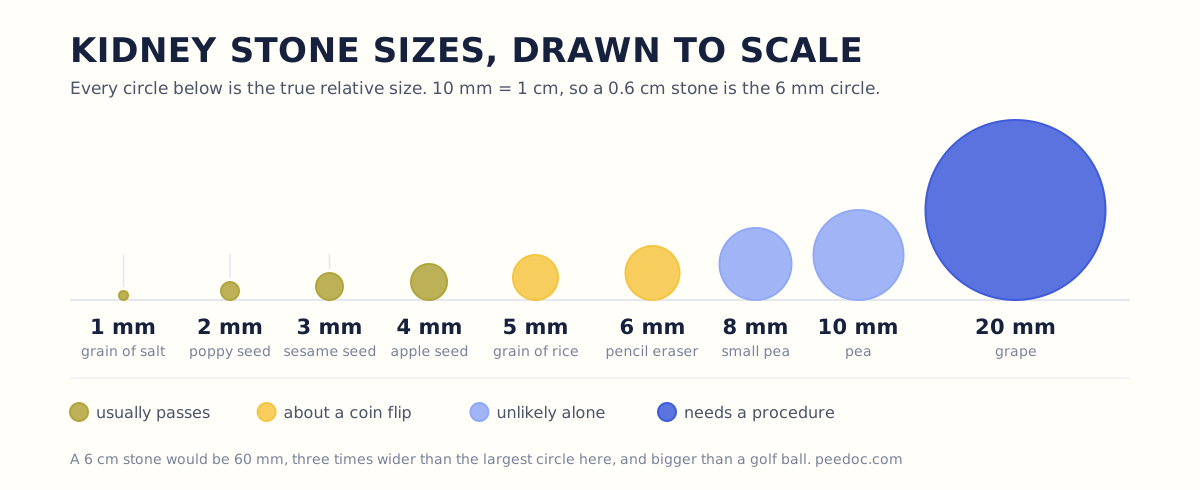
A 6 mm stone is about the size of the eraser on a pencil. A 6 cm stone is bigger than a golf ball. In twenty years I have seen a handful of stones that size, and every one of them went to the operating room.
So read your report again. If there is a decimal point in front of the number, you are in millimeter territory, and the rest of this page is mostly good news.

How stones get measured
On a CT scan, which is the test we use for stones, the radiologist reports the largest dimension of the stone in millimeters. Sometimes you get all three dimensions. The one that matters most is the widest one, because that is what has to fit through the ureter.
The ureter is the tube from the kidney to the bladder. It is roughly 3 to 4 mm across when it is relaxed, and it stretches. That stretching is most of what stone pain is. It has three natural narrow points: where it leaves the kidney, where it crosses over the pelvic blood vessels, and where it enters the bladder. That last one is the tightest, and it is where stones most often get stuck. It is also, fortunately, the closest to the finish line.
What each size actually means
| Size | About like | What usually happens |
|---|---|---|
| 1 to 2 mm | Grain of salt to a poppy seed | Almost always passes, often without you knowing |
| 3 mm | Sesame seed | Usually passes |
| 4 mm | Apple seed | Usually passes, may hurt on the way |
| 5 mm | Grain of rice | Coin flip, leaning toward passing |
| 6 to 7 mm | Pencil eraser | Coin flip, leaning the other way |
| 8 to 9 mm | Small pea | Unlikely on its own |
| 10 mm (1 cm) | Pea | Rarely passes, usually needs help |
| 20 mm (2 cm) | Grape or marble | Needs a procedure |
| 60 mm (6 cm) | Bigger than a golf ball | Needs surgery, usually through the back |
The odds, honestly
I want to be straight about these numbers, because you will see them quoted with more confidence than they deserve. Different studies report different figures, the populations are not identical, and no chart knows anything about your particular stone. What follows is the general shape of it.
Stones under 4 mm pass on their own something like 80 percent of the time. Between 4 and 6 mm it drops to roughly 60 percent. Above 6 mm you are looking at 20 percent or so, and by the time you reach a centimeter, spontaneous passage is uncommon enough that we usually stop waiting and start planning.
Location changes those odds as much as size does. A stone sitting up near the kidney passes less than half the time. A stone that has already made it down near the bladder passes around three quarters of the time. If your report says "distal ureteral stone," that is the good address.
How long it takes
Most stones that are going to pass do it within four to six weeks. Small ones often go in a week or two. A 5 mm stone can take a month and a half, and those are long weeks.
Four to six weeks is also about how long it is reasonable to wait, assuming your pain is controlled, you are not vomiting, you have no infection, and your kidney function is holding. Past that window the risk of leaving an obstructed kidney alone starts to outweigh the chance the stone finally moves. Waiting is a decision you and your urologist keep re-making, not one you make once.
What actually helps it pass
Drink water. Not gallons, and not because water pushes the stone out, which it does not really do. Stay hydrated enough to keep making urine and to make the next stone less likely.
Strain your urine. This sounds like a small thing and it is not. Catching the stone tells us it is out, which ends the waiting, and sending it for analysis tells us what it was made of, which helps us know how to keep you from doing this again. Most people who form one stone form another.
Anti-inflammatories work better than you would expect for stone pain, when your kidney function allows them. Ask before you take them.
Tamsulosin, which most people know as Flomax, is worth a paragraph of honesty. It relaxes the lower ureter, and for years we handed it to everybody. Then a large trial in 2015 found no benefit, which got a lot of attention. When the dust settled, the reasonable read is that it helps a specific group: larger stones, 5 mm and up, sitting low in the ureter. For a 3 mm stone near the kidney it is probably doing nothing. It is cheap and mostly well tolerated, so it often gets prescribed anyway. That is a defensible choice. It is not a strong one.
Nothing dissolves a calcium stone, and about 80 percent of stones are calcium. Uric acid stones, which are maybe 10 to 15 percent, really can be dissolved by raising the pH of the urine, usually with potassium citrate. If you have a pure uric acid stone and you are diligent about alkalinizing your urine, you can actually do this in a fairly short time, depending on how big the stone is. It only works if the stone is the right kind. The lemon juice and olive oil and apple cider vinegar protocols do not dissolve stones. I have had patients drink some remarkable things and then pass the stone on schedule, which is not the same as the drink having done it.
When it is not going to pass
If the stone is too big, in a bad spot, or you have simply waited long enough, there are three real options.
Shock wave lithotripsy breaks the stone from outside the body with focused sound waves. No incision, you go home the same day, and you pass the fragments over the following weeks. It works best on smaller stones in the kidney or upper ureter and less well on very hard stones or heavier patients.
Ureteroscopy is a small scope up through the bladder to the stone, which we break up with a laser and remove. Highest chance of getting you stone free in one trip. Usually a stent afterward. Fair warning: the stent tends to be the part patients complain about, not the surgery.
Percutaneous nephrolithotomy is for the big ones, generally over 2 cm. A small opening in your back into the kidney, break the stone apart, pull the pieces out through a sheath. Usually one night in the hospital, sometimes same day. This is what a 6 cm stone gets.
The part that matters most
A fever with a kidney stone is an emergency. Go to the emergency room tonight.
An infected kidney behind a blocked ureter is one of the few things in urology that can kill an otherwise healthy person in a day or two. The fix is straightforward if it happens early: a stent or a nephrostomy (a drain in the kidney) to get the urine draining, and antibiotics. This is why fever plus stone pain means the emergency room now, not seeing how you feel in the morning.
Also go in, without waiting, if you have pain you cannot control at home, you cannot keep fluids down, you have only one working kidney, or you are making noticeably less urine than usual.
What to do with all this
Look at your report and find the actual number. Convert it to millimeters if you need to. If it is under 5 mm and you have no fever, you are most likely going to pass it, and the job is pain control, hydration, straining your urine, and patience. If it is over 6 mm, or it has been more than a month, or it sits high near the kidney, start the conversation about a procedure rather than waiting for a stone that has already told you what it plans to do.
And save the stone. I know it is the last thing on your mind, but it helps with the stone workup, and with keeping the next one from ever forming.